
Who we are
The Future of Evidence in Education Network strengthens the shared frameworks the field uses to judge what different forms of evidence can support, for which claims, and for which uses, so that evidence is produced, interpreted, and used with more discipline.
In a more decentralized and fast-moving evidence ecosystem, the challenge is not only producing more evidence, but developing better ways to match evidence to claims and claims to uses, whether those uses involve local decisions about practice, policy, or design, or broader efforts to build generalizable knowledge.
Our goal is to make those gaps visible and usable so funders, districts, and states can make better decisions for their communities and contexts. We develop shared frameworks, reporting standards, and practical tools to strengthen evidence-based claims and improve how evidence is interpreted at the point of decision.

What sets us apart

Many organizations review research, support researchers, or promote evidence use in policy. Those roles are important.
What is often missing is attention to the step where research findings become claims and then inform real decisions. This is where many of the most important mistakes happen.
The Network focuses on that gap. We examine whether claims are justified by the studies behind them, clarify what different types of research can and cannot support, and create practical tools—such as reporting standards and guidance—to help people use evidence more accurately in real-world contexts.
About our group
Education decisions often turn on evidence claims that are not aligned with what the underlying studies can support. Effects of programs, practices, and policies are presented without a clear comparison. Implementation requirements and opportunity costs are left vague. Benefits are assumed to carry across settings and student populations without the information needed to judge whether that is plausible. At the same time, the number and variety of organizations producing education evidence has grown faster than shared norms for describing what evidence does and does not justify.
A central insight from our kickoff convening (December, 2025) was how often this evidence-claim mismatch recurs across settings, organizations, and decision points, including cases where the underlying studies are strong. The problem is not only study quality. It is also how findings are packaged, interpreted, and turned into decision claims.
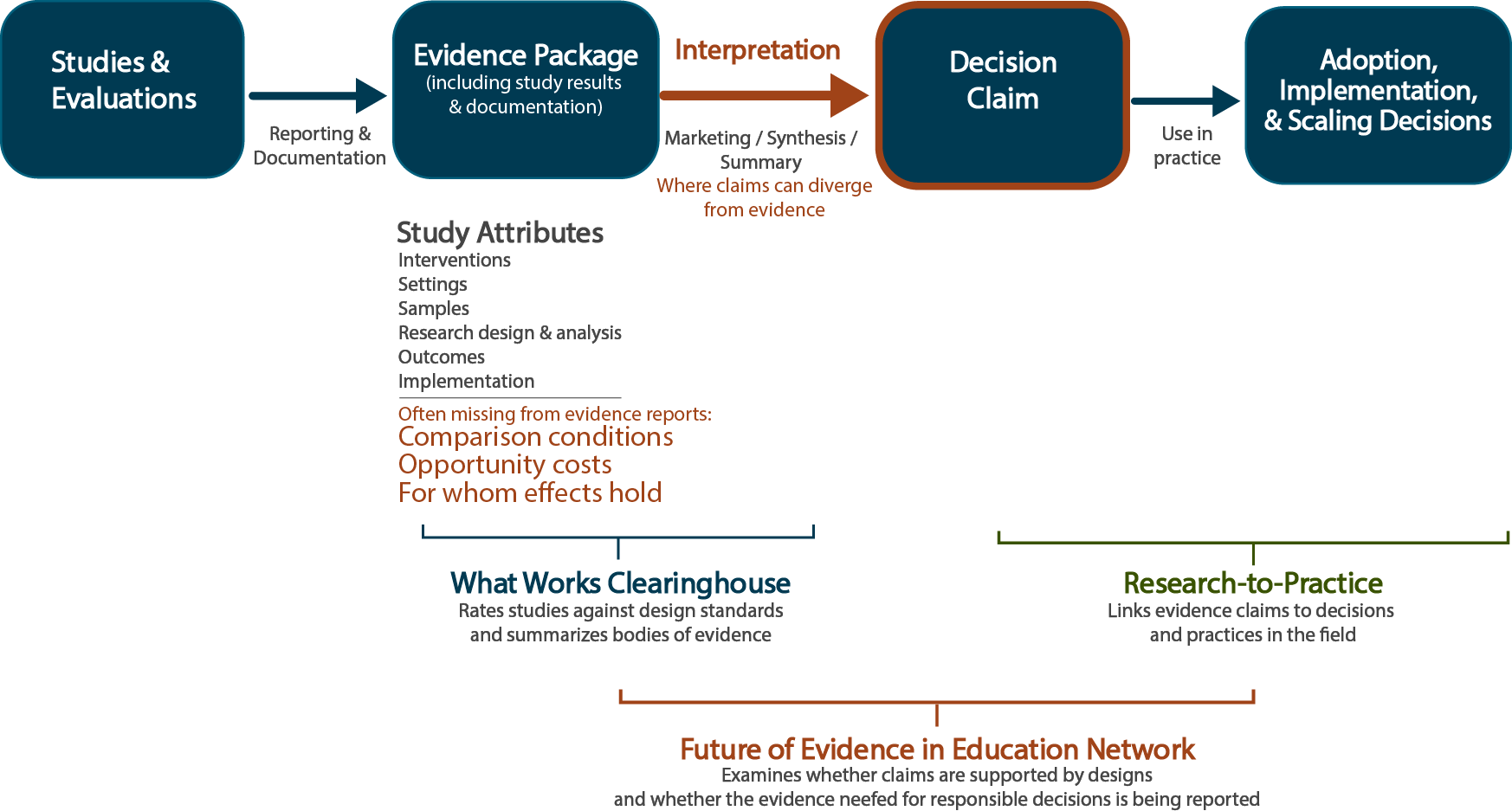
The figure below shows a simplified pathway from studies and evaluations to adoption and implementation decisions. It is not a full map of the education evidence ecosystem. But it highlights a critical point where findings are translated into claims, and where interpretation, synthesis, and marketing can produce claims that go beyond what the evidence supports.
Why now
Education research has always been produced through multiple channels. With tighter federal funding, fewer large multi-site trials will be fielded, and more evidence will be generated and used through decentralized actors on faster cycles.
AI and education technology intensify this dynamic: products change quickly, platforms produce abundant metrics that are easy to over-interpret, and performance claims are treated as proxies for educational impact. Decision-makers want guidance for specific settings and student groups, while many rigorous studies estimate average effects for defined populations under defined conditions.